
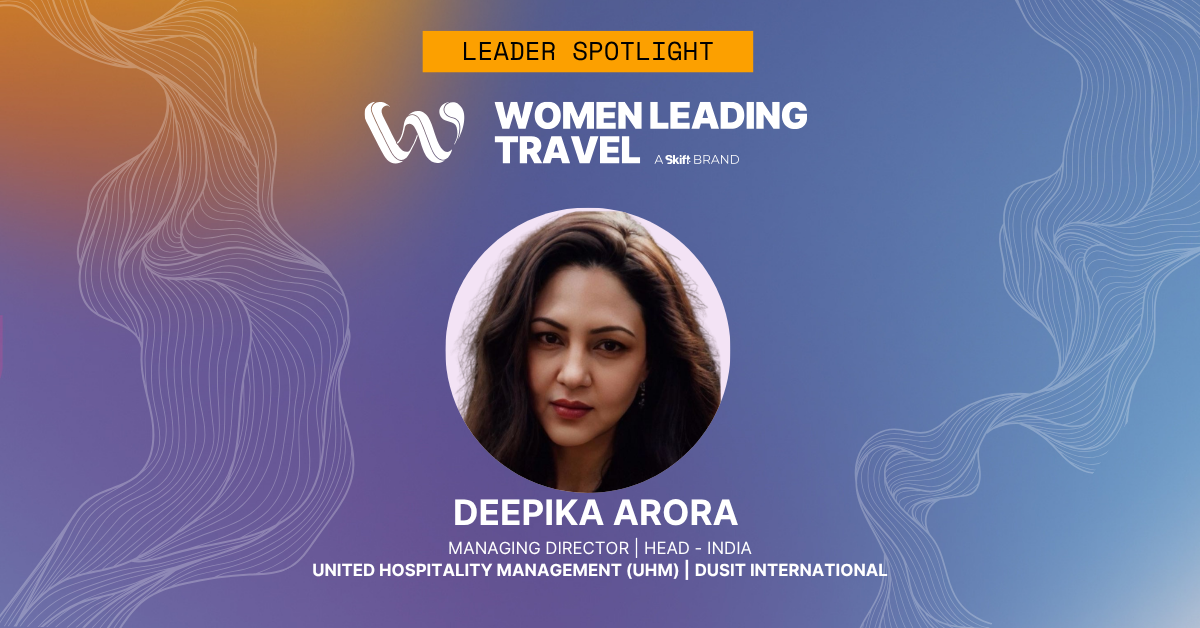
Deepika Arora, Managing Director, United Hospitality Management (UHM), & Head - India, Dusit International
As Women Leading Travel continues to expand our global reach as part of the Skift family, we are proud to amplify the voices of women shaping the future of travel across every region.
In celebration of our inaugural Women Leading Travel Asia Global Leadership Exchange in Bangkok on April 28, 2026, we’re spotlighting leaders driving meaningful change across the industry in Asia. Among them is Deepika Arora, Managing Director, United Hospitality Management (UHM) and Head - India, Dusit International, whose perspective reflects both the complexity and opportunity defining India’s fast-evolving hospitality landscape.
What does leadership in travel look like in your market right now?
Leadership in India’s travel market requires balancing commercial discipline with contextual sensitivity. The sector is expanding rapidly but is increasingly layered and nuanced. Growth spans leisure, experiential, spiritual, wellness and business travel, each shaped by distinct regional and cultural dynamics -- treating the market as uniform would be a miscalculation.
At the same time, traveller intent is evolving. Guests are more informed and values-driven, prioritising authenticity, sustainability and relevance to place. This requires leaders to think beyond short-term metrics and focus on long-term brand credibility.
Ownership structures add complexity. Many assets remain entrepreneur-led, so leadership requires strong partnership -- aligning global systems with local intelligence. Ultimately, leadership today is about calibration: balancing ambition with patience, scale with identity and short-term performance with long-term relevance.
What is your inspiration?
My path into hospitality was not pre-planned. I began in design and real estate, focusing on development and asset value. Over time, I became more interested in how spaces are experienced by people.
Visiting completed properties, I saw how one environment could mean something entirely different to each guest. That shifted my perspective -- hospitality is not just about building assets, but creating settings for meaningful moments.
That intersection between commercial discipline and human experience continues to inspire me.
What transformation are you navigating this year?
This year has been about expanding my perspective as a leader. Earlier in my career, I was deeply involved in operational and development detail, which built strong executional depth.
As my role has evolved, the focus has shifted to shaping direction, strengthening organizational alignment and anticipating future inflection points.
A key part of this transition has been building leadership depth within the organization. Empowered teams create resilience, and that strength compounds over time. Personally, this phase has reinforced the importance of clarity and prioritization -- focusing on what truly drives impact.
What challenges do women leaders face in your region?
One critical challenge is access to financial and strategic decision-making roles. While representation in operational leadership has improved, influence at the level of ownership, capital allocation and long-term strategy remains limited.
The issue is not capability, but exposure. Without early access to profit-and-loss responsibility and asset-level thinking, progression into strategic roles narrows. Organisations must be more intentional in creating pathways into these areas.
How do you use your voice in leadership spaces?
I focus on preparation and clarity. In a commercially driven industry, decisions are grounded in numbers, risk, and long-term positioning. When your perspective is well-informed, it earns space.
I also approach discussions with a solutions mindset. Over time, consistency builds credibility. Representation matters, but influence is ultimately built through reliability and substance.
What leadership skill has been most critical to your growth?
Composure under pressure.
Hospitality is inherently volatile -- demand shifts, projects evolve and external factors disrupt plans. In these moments, teams look to leadership for stability.
Taking time to assess facts, communicate clearly and respond calmly leads to better outcomes and stronger trust. Growth, for me, has been defined by the ability to navigate both strong and challenging cycles with consistency.
What does progress in travel mean to you?
For me, progress begins with the guest experience -- but it must extend beyond it. Growth should enhance authenticity and consistency, not dilute them.
In India’s current growth phase, progress also means strategic adaptability -- understanding regional dynamics, working with local partners and aligning expansion with long-term demand.
Equally, progress must be reflected in leadership, with greater representation at strategic levels. True progress is responsible growth that strengthens both business and ecosystem.
What trend are you watching most closely?
The shift toward intentional, experience-led travel.
Across Asia, and particularly in India, travelers are seeking more immersive and restorative journeys -- wellness, nature and culturally rooted experiences. Luxury is becoming more inward-looking, defined by balance rather than display.
What stands out is the need to pair this depth with operational discipline. Authenticity must be supported by strong systems to deliver consistently.
How do you balance ambition with sustainability?
Ambition without discipline can become unsustainable.
Professionally, I’ve learned to pause and assess whether the organization has the depth and systems to support growth responsibly. That pause is not hesitation -- it is calibration.
Personally, balance requires boundaries. Being constantly available does not equate to effectiveness. Sustainability is about managing energy, not just time.
What experience most shaped your leadership perspective?
Moving from corporate roles into entrepreneurship -- and navigating that journey through the pandemic.
It shifted my understanding of value creation. As an entrepreneur, you define not just performance, but purpose and positioning. The pandemic reinforced patience, resilience and disciplined rebuilding.
It also deepened my belief in boutique, community-driven hospitality -- models that are personal, rooted and sustainable while remaining commercially viable.
What advice would you give women building careers across borders?
Take ownership of your path. Adapt to different markets, but don’t dilute your core values.
Confidence in decision-making, combined with knowing when to seek guidance, is key. And staying grounded -- through family, wellbeing and relationships -- provides stability.
Long-term success comes from evolving with change while maintaining authenticity.
What motivates you on difficult days?
Clarity and perspective.
I focus on what can be controlled and break challenges into actionable steps. Maintaining physical fitness also helps me reset and stay balanced.
Ultimately, it’s the long-term vision that sustains motivation -- short-term setbacks rarely define the outcome.
Where is your favourite place you’ve travelled to -- and why?
I don’t define travel by a single destination. It’s about how a place makes you feel.
Jawai in Rajasthan stands out -- its raw landscapes and stillness create a sense of calm and perspective. More broadly, I’m drawn to moments like watching a sunset -- simple pauses that bring balance.
What excites you about connecting with women leaders in Bangkok?
The opportunity to share perspectives across culturally aligned markets.
India and Thailand both have deeply rooted hospitality traditions, where service reflects cultural identity. Forums like this create space for meaningful dialogue and encourage more women to engage in strategic conversations.
That exchange strengthens the broader ecosystem.
What would you want other women in travel to know about you?
That unconventional paths are possible.
My journey -- from architecture to hospitality to entrepreneurship -- required adaptation and conviction. It reinforced that skills are transferable and that reinvention is always possible.
Progress is built through preparation, persistence and the willingness to move forward despite uncertainty.
What role should Women Leading Travel play in Asia?
It creates space for meaningful exchange among women shaping the industry.
Its impact lies in normalizing women’s presence in strategic roles and strengthening leadership pipelines across the region -- helping build a more balanced and forward-looking industry.
Connect with Deepika on LinkedIn to follow her work and join the conversation shaping the future of travel in Asia.