
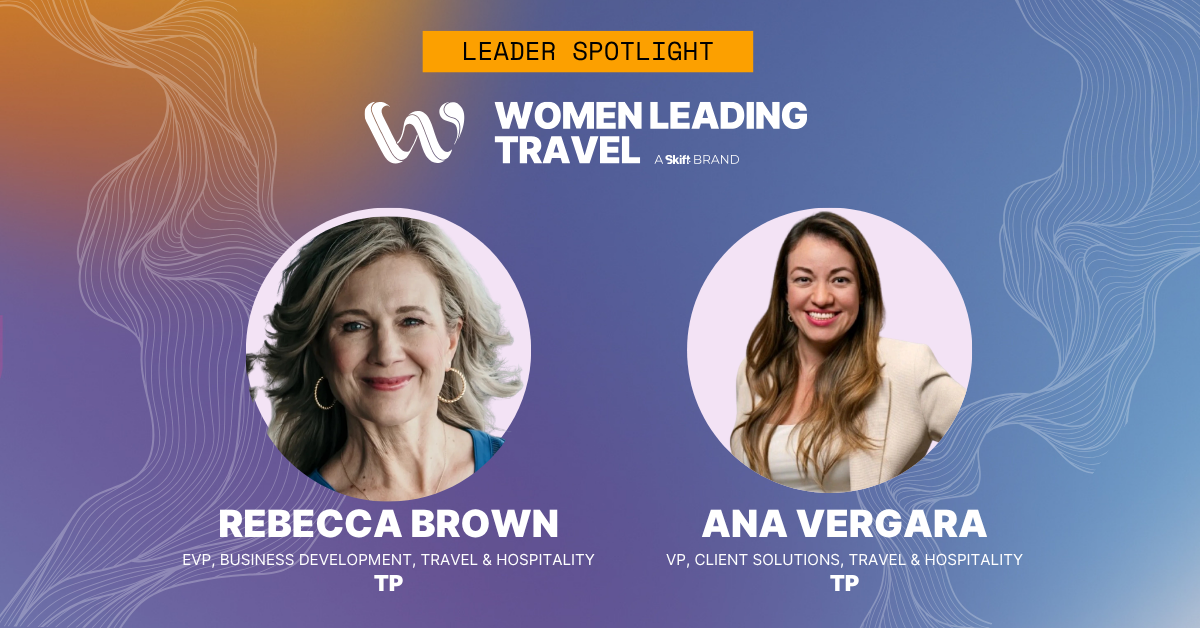
Spotlight: Rebecca Brown, Executive Vice President of Business Development, and Ana Vergara, Vice President of Client Solutions at TP

Skift Take
The future of travel customer experience depends less on individual interactions and more on how well brands connect every part of the journey behind the scenes.
The travel industry is reaching a point where delivering a consistent customer experience has become both more important and more difficult. AI is reshaping how journeys begin, disruption continues to define how they’re remembered, and expectations for speed, personalization, and seamless recovery are rising faster than most systems were built to support.
Incremental improvements to service are no longer enough in this environment. The companies pulling ahead are the ones that can coordinate data, technology, operations, and human support into an experience that feels consistent from start to finish.
Few leaders are closer to this transformation than Rebecca Brown, Executive Vice President of Business Development, and Ana Vergara, Vice President of Client Solutions at TP. Working at the intersection of global travel brands, complex service operations, and emerging AI capabilities, they bring both a strategic and operational perspective on what it takes to deliver experience at scale.
Ahead of the Women Leading Travel Forum in New Orleans this June, they share a forward-looking view on how orchestration is redefining customer experience, where AI and human expertise intersect, and what leaders must do now to build travel experiences that hold up in the moments that matter most.
We’re hearing a lot about a shift from service delivery to service orchestration. What does that mean for travel brands right now?
Rebecca Brown: Service delivery is about responding to individual interactions. Orchestration is about coordinating the entire journey. That distinction matters more now than ever because travelers don’t experience touchpoints — they experience whether everything works together.
Ana Vergara: Travel is inherently complex. You’re managing airlines, hotels, partners, loyalty systems, and disruptions across all of them. Orchestration means connecting people, AI, and data in real time so that when something happens, the system responds as one, not in fragments.
Traveler expectations seem to be evolving faster than many travel systems can adapt. What’s driving that disconnect?
Brown: Expectations have fundamentally changed. Travelers now expect speed, personalization, and zero friction every time. They don’t differentiate between industries. They compare their airline experience to the best digital experience they’ve had anywhere.
Vergara: AI is accelerating that shift. It’s not just improving service. It’s reshaping how travelers discover, plan, and make decisions before they even reach your brand.
How should travel leaders think about AI in this new environment?
Vergara: The biggest misconception is that AI replaces people. The reality is that AI changes how work is orchestrated. AI can understand intent, surface knowledge, and coordinate workflows instantly. However, the moments that define loyalty, especially in travel, still require human judgment and empathy.
Brown: The winning model is not AI or human. It’s both, intentionally orchestrated. When you get that balance right, you improve speed, consistency, and experience simultaneously.
You both emphasized disruption as a defining moment for customer experience. Why is that so critical?
Brown: It’s critical because disruption is where expectations peak. When a trip breaks, customers shift from asking questions to expecting a resolution.
Vergara: That’s where most systems break down. Processes such as rebooking, policy checks, partner coordination, notifications, and escalation often sit in different systems and teams. Orchestration brings those together so the traveler experiences a single seamless response rather than multiple disconnected steps.
Many travel companies talk about personalization, but personalization at scale requires enormous coordination behind the scenes. What role does data play in making that possible?
Vergara: Data is foundational. Without access to the right customer, booking, and operational data, orchestration simply doesn’t work.
Brown: This is where many organizations are still catching up. Customer experience is no longer just a front-office function. It requires alignment across IT, operations, and governance. The challenge isn’t the AI itself. It’s connecting the ecosystem around it.
How is the role of the contact center evolving in this model?
Brown: The contact center is becoming an orchestration hub. As AI absorbs repetitive work, the human role shifts toward exception handling, relationship management, and revenue protection.
Vergara: It becomes the place where complex journeys are resolved and where trust is reinforced. That’s a very different role than traditional volume handling.
What are the biggest structural or operational barriers preventing travel brands from delivering truly connected customer experiences?
Vergara: Fragmentation is the biggest barrier. Systems, servicing rights, and partners all operate independently, which makes coordination difficult.
Brown: Organizations are often still optimizing individual parts of the journey rather than designing it end-to-end. That mindset has to change.
As travel enters an era of greater AI-driven automation and operational complexity, what should leaders prioritize now to stay competitive?
Brown: First, design for AI-mediated journeys, not just digital channels. Second, connect your data and clarify servicing rights. Third, be very intentional about how AI and humans work together.
Vergara: Choose partners that are built for orchestration. This is not something you layer on. It has to be part of the operating model from the start.
What excites you most about the future of the travel customer experience?
Vergara: What excites me most is the opportunity to make travel feel effortless again, even in complex situations.
Brown: And the leadership driving it. The conversations at forums like Women Leading Travel show that the industry is moving beyond incremental improvement and toward fundamentally rethinking how experiences are delivered.
As you prepare for the Women Leading Travel Forum, what’s one idea or mindset you hope leaders leave the conversation thinking more seriously about?
Brown: Customers don’t see your systems. They see their journey.
Vergara: The brands that win will be the ones that orchestrate that journey best.
Connect with Rebecca and Ana on LinkedIn to learn more.
This content was created collaboratively by TP and Skift Studio.